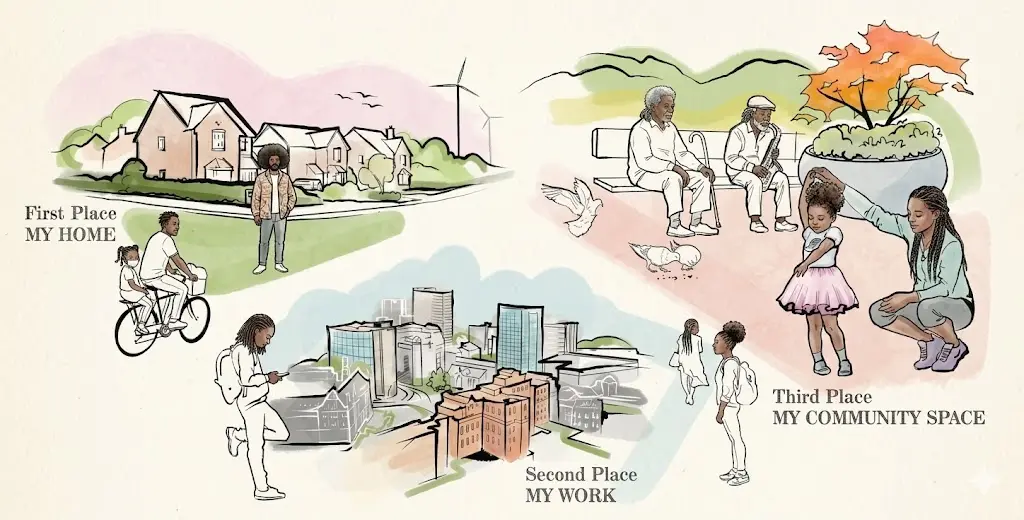
There was a time when community didn’t need planning. It lived in the spaces between things.
Before you even stepped into your grandparents’ house, you would find it on the porch. Someone seated, someone leaning, someone passing by and stopping “just for a minute” that turned into an hour. Conversations spilled into the open air, unstructured, unhurried. You didn’t need an invitation. Presence was enough.
Homes were built with this in mind. Not just as places to live, but as places to gather. You would find women seated outside, hands moving rhythmically as they braided each other’s hair, laughter rising and falling with the stories they carried. News traveled this way, not through headlines, but through voices. Through shared glances. Through the kind of knowing that only comes from being near each other often enough.
After church, no one rushed home.
There was always somewhere to go. A nearby house. A patch of grass. The church grounds themselves. Juice passed around in plastic cups, plates of something small but generous, and conversations that stretched long past the final hymn. Children ran in circles while adults sat and spoke about life in ways that felt both ordinary and profound.
And then there were the barbershops.
Not just for haircuts, but for becoming. Boys sat quietly at first, listening. Absorbing. Learning the language of men, not always perfect, not always polished, but real. It was one of the few spaces where men gathered without pretense. Where conversations ranged from the surface to the deeply personal without needing a formal invitation to go there.
Even hospitals, in their own way, carried a certain kind of warmth. There was a sense however imperfect, that care extended beyond procedure. That people mattered in the process. These were not extraordinary places and that’s probably what made them powerful. They were what Ray Oldenburg would later call Third Places, spaces outside of home and work, where community forms naturally. Where you don’t have to perform. Where you are not timed. Where you can arrive as you are and stay as long as you need.
We didn’t call them that back then.
We just lived them.
But somewhere along the way, we redesigned life around more of efficiency. We have built homes that close us in instead of opening us out. Corridors instead of courtyards, elevators instead of encounters. You can live next to someone for years and never know their name, and not because you don’t care, but because nothing in the design insists that you should.
We have optimized for privacy and called it progress. Replaced proximity with convenience. Moved faster, but we stopped meeting. Even connection became something we schedule. Something we budget time for. Something that has to justify itself you know? You meet someone for coffee and suddenly there’s an invisible meter running. Stay too long without ordering again and you feel it, the shift, the subtle suggestion that your presence needs to keep paying for itself.
We have created spaces where you can be present but not linger. And without lingering, something essential disappears. Because community has never been built in urgency. It is built in excess time. In the conversations that go past their natural ending. In the decision to stay a little longer when you don’t need to. In the quiet repetition of seeing the same faces often enough that they stop being strangers. We’ve also stretched our lives across distance.
Cars made it easier to move, but in doing so, they dissolved the local. Places of worship grew bigger, drawing people from miles away, and in the process, became less intimate. You attend, you leave, and the in-between, the part where community actually forms, gets lost.
We now have more access than ever before. And somehow, less belonging. Not because people don’t want connection. But because the environments we move through don’t support it. And yet, the desire keeps showing up. You can feel it in the way people linger when they finally find a space that allows them to. In the way laughter becomes fuller when no one is watching the time. In the way strangers soften when they realize they are not expected to be anything other than human.
This is why spaces like Outdoorer matter more than they might seem at first glance.
Because what is a hike, really?
It is not just movement.
It is a return.
A return to something older than all of this. Walking side by side. Talking without pressure. Pausing together. Sharing water. Waiting for each other at the incline. Laughing when someone slips slightly on loose gravel. It is community without instruction. Over time, something shifts. People start to recognize each other. Names come easier. Conversations pick up where they left off. Friendships form, not because anyone forced them to, but because the space allowed them to.
Some people meet their closest friends there. Some meet their life partners. Some stand at weddings that began with a simple, “Hi, is this your first hike?” (Yes, we have partners who have met at Outdoorer, and not just one in fact). And just like that, a Third Place re-emerges.
Under open sky.
In a space where no one is timing you, where no one is asking you to perform, where you can simply exist alongside others, even if you arrived alone (turn back time doesn’t count here :)) Maybe that’s what we’ve been looking for. Not something new. Something we lost quietly.
A place where we don’t have to earn our belonging.
Lily Waithaka | The Storyteller 🧘🏾♀️
Lily Waithaka is a writer and creative voice at Outdoorer, where she curates a reflective series on belonging, community, and the quiet lessons the outdoors continues to teach us. Her work weaves together story and stillness, reminding readers that healing often begins in connection and with nature. Through her reflections, she explores what it means to belong, to the land, to each other, and to ourselves. Each trail and story is a return.